
Key Highlights:
- SEC and CFTC to team up and harmonize crypto and DeFi rules.
- Focus will be placed on prediction markets, perpetuals, and portfolio margining.
- September 29 roundtable set to chart the next steps for U.S. competitiveness.
The U.S. Securities and Exchange Commission (SEC) and the Commodity Futures Trading Commission (CFTC) have recently announced that they are teaming up and will set up coordination on areas such as crypto and decentralized finance (DeFi), and other various financial products. The main goal of this collaboration is to fix gaps in regulation, update rules and keep U.S. markets competitive. This development was highlighted by well-known crypto journalist Eleanor Terrett on X (formerly known as Twitter).
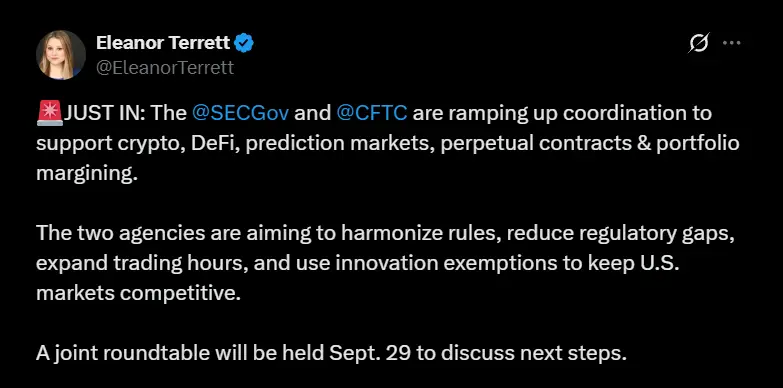
According to the post, the two agencies will also be holding a joint roundtable on September 29. In this roundtable, regulators, industry leaders, and academics will be coming together to discuss rules for crypto assets, prediction markets, perpetual futures and portfolio margining.
Closing Gaps in Crypto Oversight
Crypto rules in the U.S. have long been messy and confusing, with various agencies claiming different pieces of the puzzle. The SEC is supposed to look after the securities and the CFTC is supposed to look after and handle commodities along with derivatives. The problem here is that many crypto products do not fall under either of these categories. This has caused endless confusion and arguments within the industry over things like: if stablecoins or perpetual contracts should be treated as securities or commodities.
The main aim is to make sure that the rules do not overlap, it cuts down on compliance headaches, and to create a fairer environment for U.S. exchanges, brokers, and DeFi platforms.
This joint venture has also come forward at a time when the Congress is still debating several bills on crypto regulations. Instead of waiting for lawmakers to decide, the agencies are showing that they can move forwards on their own to make oversight more consistent and easier to get through.
Expanding Trading Hours and Market Access
Another thing that is grabbing focus is the market structure. As we all know that crypto trades 24/7, regulators due to this reason are now looking at whether U.S. markets should be extending trading hours for some products or not, especially futures and digital assets.
As of now, traditional U.S. markets are making a run on limited schedules, while global crypto exchanges just do not close. Extended trading hours could make markets more efficient, improve price discovery and attract bigger investors who are willing to have access around the clock.
Innovation Exemptions: A Sandbox for Finance
The SEC and CFTC are also considering special innovation exemptions and they would let regulated companies test new products under strict oversight. The idea here is to use waivers or pilot programs to encourage experimentations in areas such as decentralized prediction markets, perpetual futures contracts and portfolio margining.
This exemption could give firms legal clarity while still protecting investors. But some critics warn that if this is not handled properly, they could create loopholes that can pose a threat to the safety of the investors.
Strategic Timing
This step comes as regions such as the EU, Singapore and Hong Kong are rolling out full crypto frameworks. On the contrary, U.S. regulation has been seen as patchy and driven mostly by the lawsuits. The Sept. 29 roundtable is meant to showcase that the SEC and CFTC are synced and are serious about keeping the U.S. competitive in the financial innovation sector.
What’s Next?
Once the roundtable wraps up, the agencies will have to publish a report where in they put in all the recommendations and potential rule changes that they have discussed. The road ahead is still not clear but still a lot of people in the industry think that this is one of the most encouraging regulatory step for crypto in 2025.
Also Read: SEC’s Spring 2025 Plan Signals Big Change for Crypto Rules