
Key Highlights:
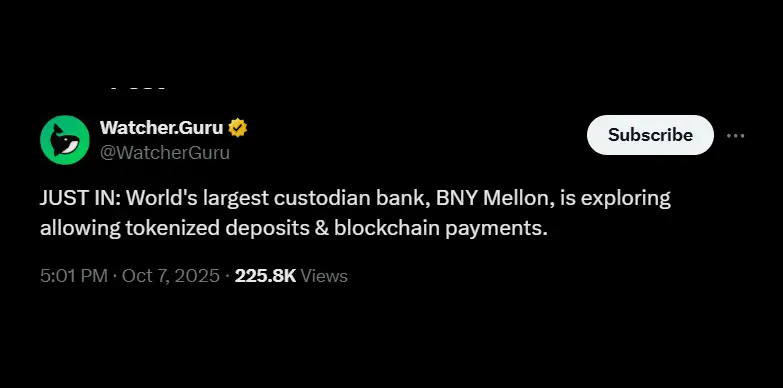
- BNY Mellon is currently exploring tokenized deposits on the blockchain.
- The main aim is to modernize the global payment systems and methods through tokenization.
- Exploring tokenization also indicates rising institutional adoption of digital infrastructure.
BNY Mellon, the world’s largest custodian bank holding more than $47 trillion in assets under custody, is accelerating its move into blockchain technology and digital assets. The banking powerhouse is currently investigating tokenized deposits and blockchain-powered payment systems. This move indicates a strong effort by a traditional bank to bring distributed ledger technology (DLT) into everyday banking services.
Pioneering Blockchain Integration in Banking
As a part of this transformation, BNY Mellon is exploring how tokenization, a process that turns various traditional assets like cash deposits into digital tokens on a blockchain, has the ability to transform payments, settlements worldwide.
According to sources, this research builds on the bank’s previous blockchain custody experiments and investments in digital infrastructure partners. BNY Mellon has been supporting the blockchain industry for a while now. It has also allowed its clients to hold and move Bitcoin, Ethereum through its digital custody platform that was launched in 2022.
BNY Mellon’s new initiative is not just about handling cryptocurrencies like Bitcoin and Ethereum anymore. Instead, it is about moving deeper into traditional banking how regular bank deposits can be converted into digital tokens on a blockchain. In other words, the bank is trying to apply blockchain technology to the core of everyday banking, not just to digital assets.
Understanding Tokenized Deposits
As mentioned above, tokenized deposits are digital versions of regular bank deposits. They are issued on a blockchain, however, they are fully backed by real money held at a regulated bank. Unlike stablecoins, which are usually issued by non-banks, tokenized deposits stay within the traditional banking system and follow existing regulations.
The main idea here is to gain attention from central banks and major financial institutions because it can make payments faster, improve transparency, and simplify record-keeping. BNY Mellon’s move is progressive and it shows how its plan for tokenization can strengthen the financial system and work alongside other digital currencies, like central bank digital currencies (CBDCs) and regulated stablecoins.
Competitive Positioning Among Global Banks
BNY Mellon is not the only bank that has been supporting this idea. JPMorgan, Citibank, and HSBC have all tested or launched blockchain-based payment systems to tokenized deposits and speed up settlements. For example, JPMorgan’s Onyx platform has processed billions in tokenized transactions using its JPM Coin.
BNY Mellon wants that their system should also be ready for the next wave of digital finance and hence it is wanting to adopt similar technology.
Analysts say that this move could make the bank more attractive to institutional clients who want faster, programmable and more secure settlements.
Regulatory and Industry Implications
The U.S. rules for tokenized banking products are still changing and evolving, but banks like BNY Mellon are actively participating in shaping them. The bank’s involvement helps guide potential rules on interoperability, data security and compliance.
According to experts, tokenized deposits could help get rid of the middlemen, could improve liquidity and make settlements more transparent.
On the other hand, challenges such as meeting anti-money laundering requirements and making sure that the different blockchains work together remain.
A Step Toward a Digital Future
This step by BNY Mellon shows just how committed the bank is in combining trusted banking with advanced technology. As banking goes digital, BNY Mellon’s early trials could build a system combining traditional finance with blockchain efficiency. It may take time to be implemented fully but will be worth it.
Also Read: U.S. Debt Crisis Deepens, Bitcoin Gains Investor Trust